 |
Login
ScrumDesk can run in different scenarios, from single user up to multiple teams distributed over the globe.
User is authorized by login name and password.
Company can use multiple project databases hosted on different servers. Login screen is the place where to choose a project database. |
 |
Project selection
Developers in company are typically working on more projects simultaneously.
ScrumDesk enables to access all the projects from one place. |
 |
Project details
Scrum master can bulid development teams by choosing users from a company contact list. Developers can be grouped to the teams.
ScrumDesk integrates bug tracking systems and project documentation server (Microsoft SharePoint, wiki pages).
ScrumDesk supports customization of colors for status indication.
This screen enables to set details for project’s synchronization with other systems |
 |
Story Templates
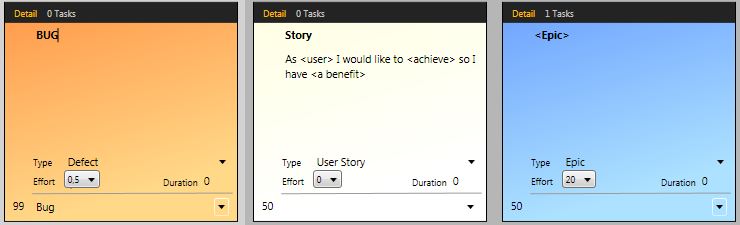
Story templates enable to create index cards templates for typical stories, for example for a bugs, feature requests, risk and so on.
To create a new story from template, select the template from a list available in a New submenu.
|
 |
Project Planning
Agile project is developed in iterations. These iterations in Scrum method are called Sprints. Sprint has its time box, main goal, start date, duration, date of a demo.
Every sprint contains stories that product owner wants to have completed in the sprint.
Planning view can be used to manage product releases, their dates and description. |
 |
Planning Poker®
Very usable technique for size estimation is Planning Poker®. ScrumDesk helps the team to view backlog stories groped by story size. Every poker round can be timed by time set before round starts.
PLANNING POKER® is a reg. trademark of © Mountain Goat Software, LLC
Sequence of values is © Mountain Goat Software, LLC |
 |
Sprint detail
Every sprint in Scrum shoud have name, goal and notes.
Sprint is time box, it starts at start date and has its length (in working days) .Every sprint in Scrum ends with product demo. This demo is typically on the end of the sprint. ScrumDesk enables to set the demo when is needed.
Velocity is maximum size of sprint stories effort that team is able to implement/ get completed. The value can be estimated using statistical data.
State of the sprint enables Scrum Master to control the progress. When a sprint is started, team members can start their stories and tasks, when sprint is marked as Done, changes of the stories are blocked. |
 |
Release detail
Product Owner can create and manage releases. Every release has its name, finish date, and brief description for the team.
Detail also displays more information about “release cost” – number of the stories, effort needed to complete the stories, % of completion. |
 |
Desk view – zoomed to full desk view
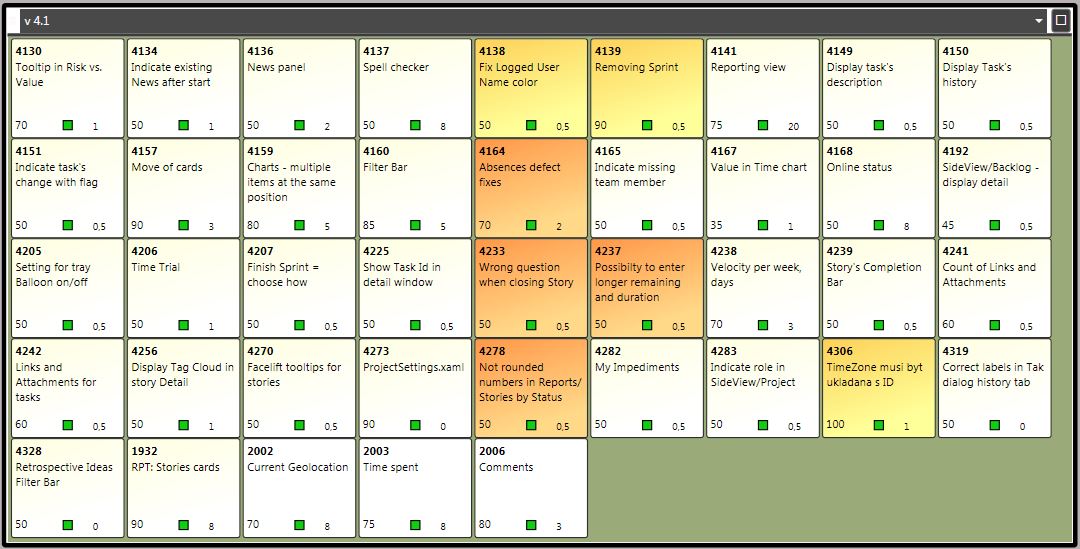
Stories are “pinned” on desk.
User can change zoom, pan the desk and arrange the story cards over the board.
This screenshots shows desk zoomed to maximum board size. |
 |
Desk view – zoomed to card detail
To get more details about the story, user can zoom out to the story card. |
 |
Task board (Kanban) view
Work with tasks and stories using task board. Manage your tasks by drag and drop, change task status, check the status using quick overview. |
 |
Treemap view
Backlog can contain many stories. It is a problem to find stories of top priority or the biggest.
Treemap is great way to visualize your stories. You can group stories, stories are colored according different story attribute. |
 |
Grid view
ScrumDesk supports also “traditional” grid view. This view provides editing, multilevel grouping and sorting.
User can change all the story details including story color or release date. |
 |
Story card
Story in Scrum can represent any feature request, bug or risk.
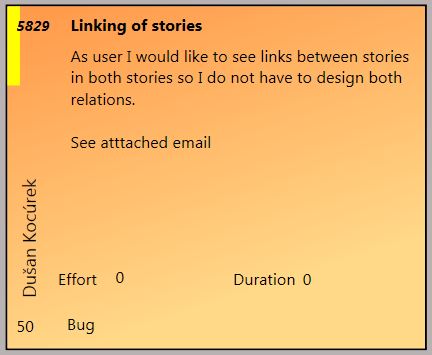
Story is displayed in a form of a card. Story has attributes such as subject, detailed description, priority, effort and estimated duration.
Every story can be in one of following states: marked as To Do, checked out, solved or completed. Story state is indicated by color strip in top left corner and can be changed easily by click on this strip.
Estimation of the story size can be easy entered from planning card as used in the Planning Poker®.
Stories can be categorized and colored. |
 |
Story tasks
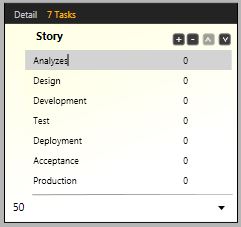
To manage project, project stories can be divided into the tasks. This is the way how work can be distributed over a team. Anyone from the team can start to work on any task.
Task is described by name, state, assigned worker, estimated duration and current remaining duration.
Order of tasks can be freely changed. |
 |
Story progress
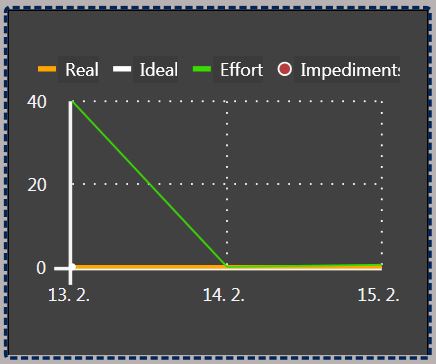
Story progress id presented in story burndown chart. This chart displays number of remaining days expected by developers in given day.
Second line shows ideal story progress. |
 |
Story color
Stories can be categorized by story color.
This color can be used to group stories by feature, priority, state, requirement type.
User can freely choose which attribute color represents. |
 |
Story details
Story card is created to display important management attributes. To see more details in one place, user can displays story detail.
In advance, this detail window displays story history, all tasks and story progress burn down chart.
Stories can be tagged. Story can have attached files. Details enables to a user to enter impediments. |


|
Story impediments
Story Detail enables user to enter impediments. Work on a story can be interrupted in any time by an unexpected reasons. This is an impediment.
Impediments are displayed in a burn down charts as well as on the index card.
|
 |
Story attachments
Story can have attached files.
ScrumDesk can upload these attachments into a project database so files are accessible to even a distributed team Attachments can be downloaded by double click.
For every attachment thumbnail is displayed. |
 |
Retrospective idea
ScrumDesk supports sprint retrospective. Anyone from the team can contribute with his/her idea.
Team member can vote for the best ideas which should be implemented to improve the process.
The retrospective card displays total points for idea. Ideas can be freely categorized, like “Mad”, “Glad”, “Sad”,… |
 |
Preview pane
Preview pane shows whole board and all story cards. Red rectangle highlight current displayed area in desk view.
Desk view can be easy scrolled by moving this rectangle. |
 |
Timeline
Time schedule of the project is displayed in one place, in a timeline.
Timeline shows sprint, demo events and releases in one place. Current day is also highlighted.
Timeline is easy scrollable by dragging. |
 |
Information panel
This panel displays sprint status overview including name, sprint state, % of completed stories, current occupation, storypoints available to be developed and number of displayed stories. |
|
 |
Sprint SideView
ScrumDesk provides easy access to a currently displayed sprint overview.
On the top of the Side View is displayed sprint name, goal and a small burn down chart. This chart shows real time calculated progress by a sprint stories details. Burn down chart displays ideal progress line too.
Next section of this view displays story statistics by state, count and an effort required to complete them. Third section displays Effort statistics with an sprint occupation indicator.
Last section enables to Scrum Master to start or finish the sprint.
Progress bar displays sprint time flow.
Clicking on Edit button details in Sprint Detail dialog can be changed. |
 |
Project SideView
This SideView displays project name and a path to the project database.
Team members are displayed as contact cards with picture, first and last name.
This list can be filtered.
Team communication is accessible by buttons at the SideView bottom. |
 |
Backlog SideView
ScrumDesk provides easy access to the stories from following sprint or from backlog. User sees all stories that needs to be developed. Mini story cards displays priority and effort. Stories can be filtered by entering filter text.
Assigning planed stories to the current sprint is very easy, just by drag and drop. Uncompleted stories can be moved to the next sprint or back to the backlog. |
 |
News SideView
When a story or an idea has been changed, notification appeared in a screen right bottom corner. These notifications are displayed in a News panel as well.
What more, after the ScrumDesk starts, it will display all changes from the user’s last logout.
|
 |
Search SideView
Stories, tasks and other assets can be searched for a text.
Results are displayed in a list that displays asset name and name of the asset’s property where text was found.
Detail of the asset can be displayed just by double click on a row. |
 |
About Me SideView
SideView panel About Me enables logged user to change contact details. First name, last name and login name are not allowed to be changed due to a ScrumDesk licensing policy. Only ScrumDesk administrator can change these details.
Picture can be changed by a click.
|
 |
Reports and metrics
- Project Dashboard
Progress is displayed in the Reports view. This view shows:
- Velocity by sprints - stories effort in sprints, maximum velocity in sprints, effort distribution by state of the stories,
- Velocity by releases – amount of storypoints distributed by releases and by state of the stories.
- Burn Down charts for sprints
- Statistics support for better sprint estimation:
- Worst 3 sprints mean
- Last 8 sprints mean
- Maximum effort
- Prioritization reports calculated based on business value
|
 |
Reports and metrics
- Parking Lot
Themes progress can be analyzed in the Parking Lot report.
Every theme is displayed as a card with:
- theme name,
- count of the theme’s stories
- number of completed story points for theme stories
- total number of story points for theme stories
- progress indicator with % of completeness
If there is no theme defined, one card with overall statistics is displayed.
|
 |
Stories by status
Report displays distribution of backlog’s stories by story status. |
 |
Daily Backlog Trend
Daily Backlog Trend displays the project progress since project’s start to current day.
On Y axe are displayed remaining story points.
On X axe are displayed days.
Sprint end is displayed as a small red circles. |
 |
Reports and metrics
- Time sheet
Managers required view on a work progress.
This report displays sprint progress in a form of the time sheet.
The time sheet is generated for all team members and selected sprint.
Under a story’s or task’s name is displayed name of the team member who is working on given tasks. In second column is displayed duration estimated before the task starts. Following columns displays values entered in a given day by the team member. In advance, for some values is displayed small arrow. Color of the arrow indicates exception of the estimated value.
Green arrow indicates advance in a progress.
Red horizontal arrow indicates that in given days no progress has been
recognized. This can indicate some unexpected problems with
implementation or that the user doesn’t update value.
Orange up arrow indicates that value has not decreased, but increased.
Values displayed with a gray color are values for other team member who participates on the given task.
Stories and tasks can be easy filtered by a click on the team member. Multiple team members can be selected. Team members can be easy filtered by a filter text box in the right upper corner of the screen.
Sprint can be selected in a combo box from left top corner.
- theme name,
- count of the theme’s stories
- number of completed story points for theme stories
- total number of story points for theme stories
- progress indicator with % of completeness
If no theme exists, one card with overall statistics is displayed.
|
 |
Filtering
Board with stories can be filtered by story state, text, themes or tags.
Stories of logged user can be filtered by checkbox “My items”. |
 |
Team collaboration
ScrumDesk team members can be easy accessible by internet phone or emails. There is no need to known nicknames or even email addresses. This is a simple way to keep every team member informed even in the teams distributed over the globe.
Supported 3rd party applications: Skype, Microsoft NetMeeting, Microsoft Office Communicator. |